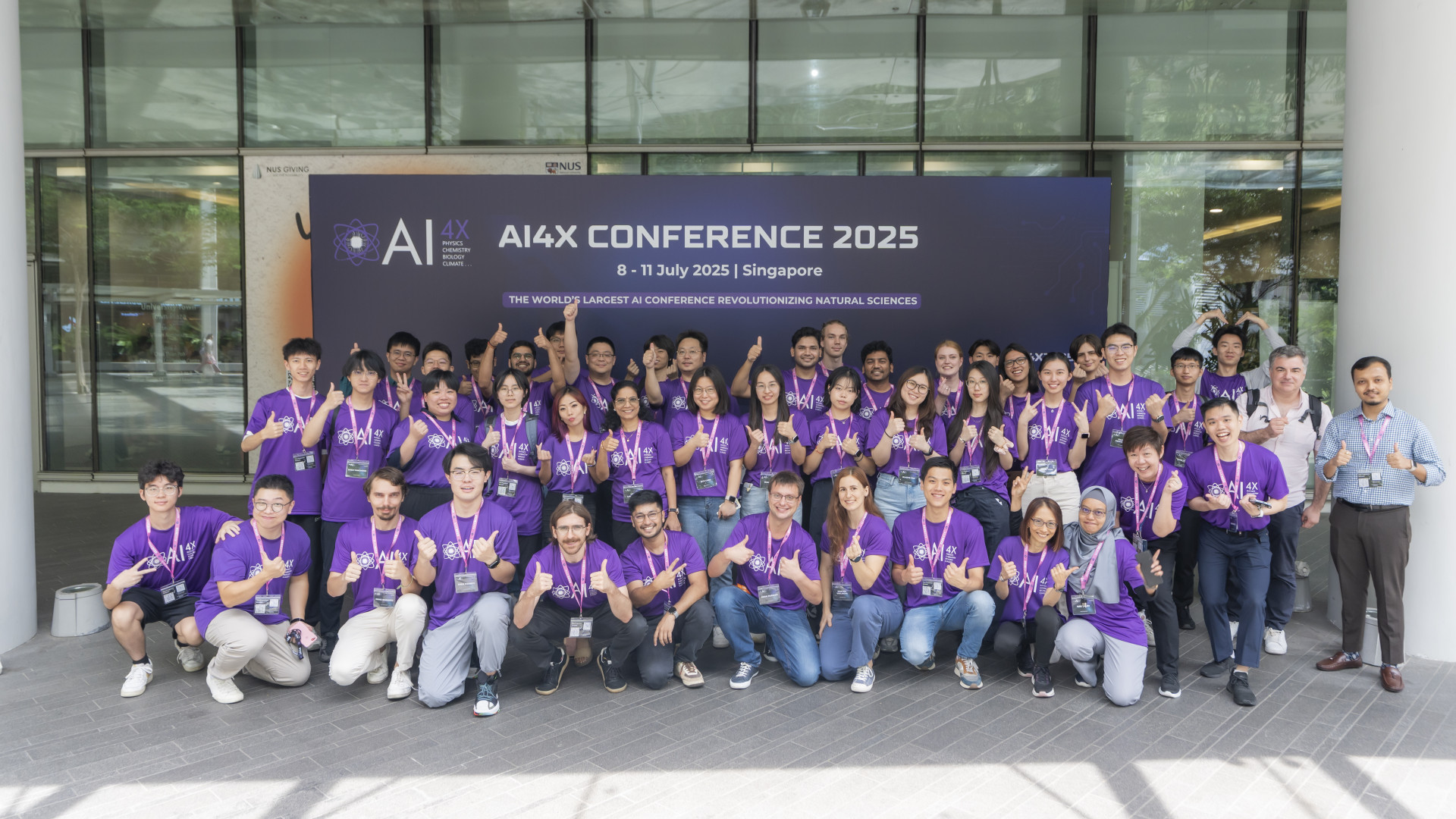
The AI4X 2025 conference – the world’s largest AI conference revolutionising the natural sciences – was organised by the NUS Institute for Functional Intelligent Materials’ (NUS I-FIM) team of staff and student helpers.
Artificial Intelligence (AI) is speeding up scientific progress in diverse disciplines, from discovering new materials, to applying generative AI to detect dementia early, to improving climate modelling approaches by employing a combination of physical, hybrid AI and fully-data driven models.
These topics and more were explored at the inaugural AI4X 2025 conference held at NUS University Town. Taking place from 8 to 11 July 2025, the conference aims to spark cross-disciplinary collaboration and breakthroughs in AI innovation, accelerating scientific discovery and translational potential on all fronts.
AI4X 2025 is jointly organised by NUS Institute for Functional Intelligent Materials (I-FIM), together with the National Research Foundation, Singapore (NRF), Singapore’s Ministry of Education, Nanyang Technological University and the DSO National Laboratories. This strong alliance reflects the relevance and importance of the field in global research. I-FIM led the full planning and execution of the conference, which included conceptualisation, programme design, speaker selection and operations.
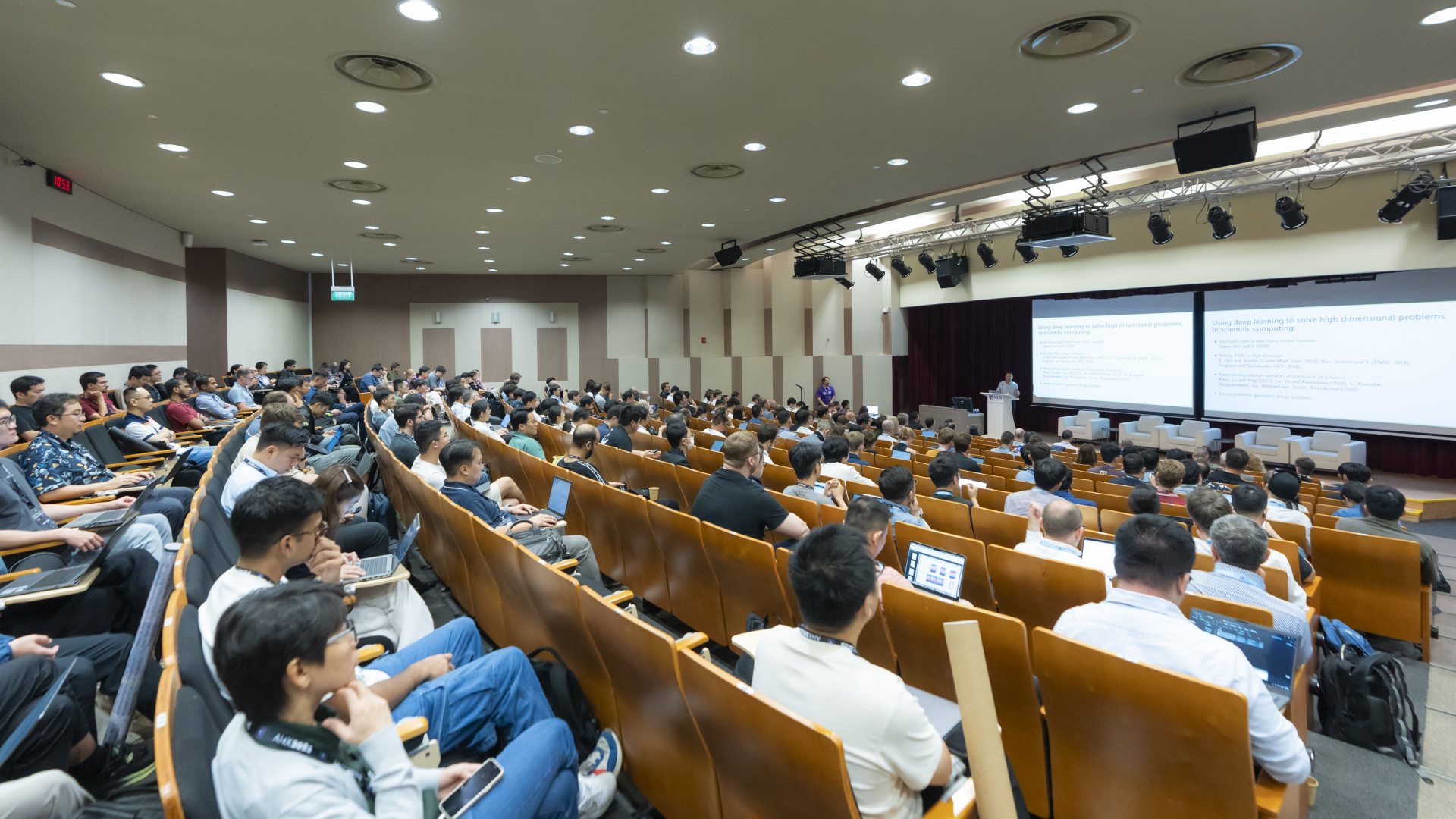
The conference featured leading speakers from academia, start-ups, and global industry laboratories who addressed the theme of AI innovation across 16 different topics.
The world’s largest AI conference revolutionising the natural sciences, AI4X 2025 gathered close to 600 global researchers and industry leaders for talks and pre-conference workshops on AI innovation across sixteen different topics. It also comprised 27 keynote talks, 16 thematic sessions, and close to 100 poster presentations.
About 80 leading speakers from academia, start-ups, and global industry laboratories – including luminaries Gerbrand Ceder from the University of California, Berkeley, Boris Kozinsky from Harvard University, and Alex Aliper from Insilico – took part in the event.
“AI is reshaping how science is done,” said AI4X conference chair Professor Sir Konstantin Novoselov, Director of NUS I-FIM and winner of the 2010 Nobel Prize in Physics.
“Through AI4X, we aim to position Singapore and I-FIM as leaders in this global transition, by convening top minds to share, debate, and drive progress.”
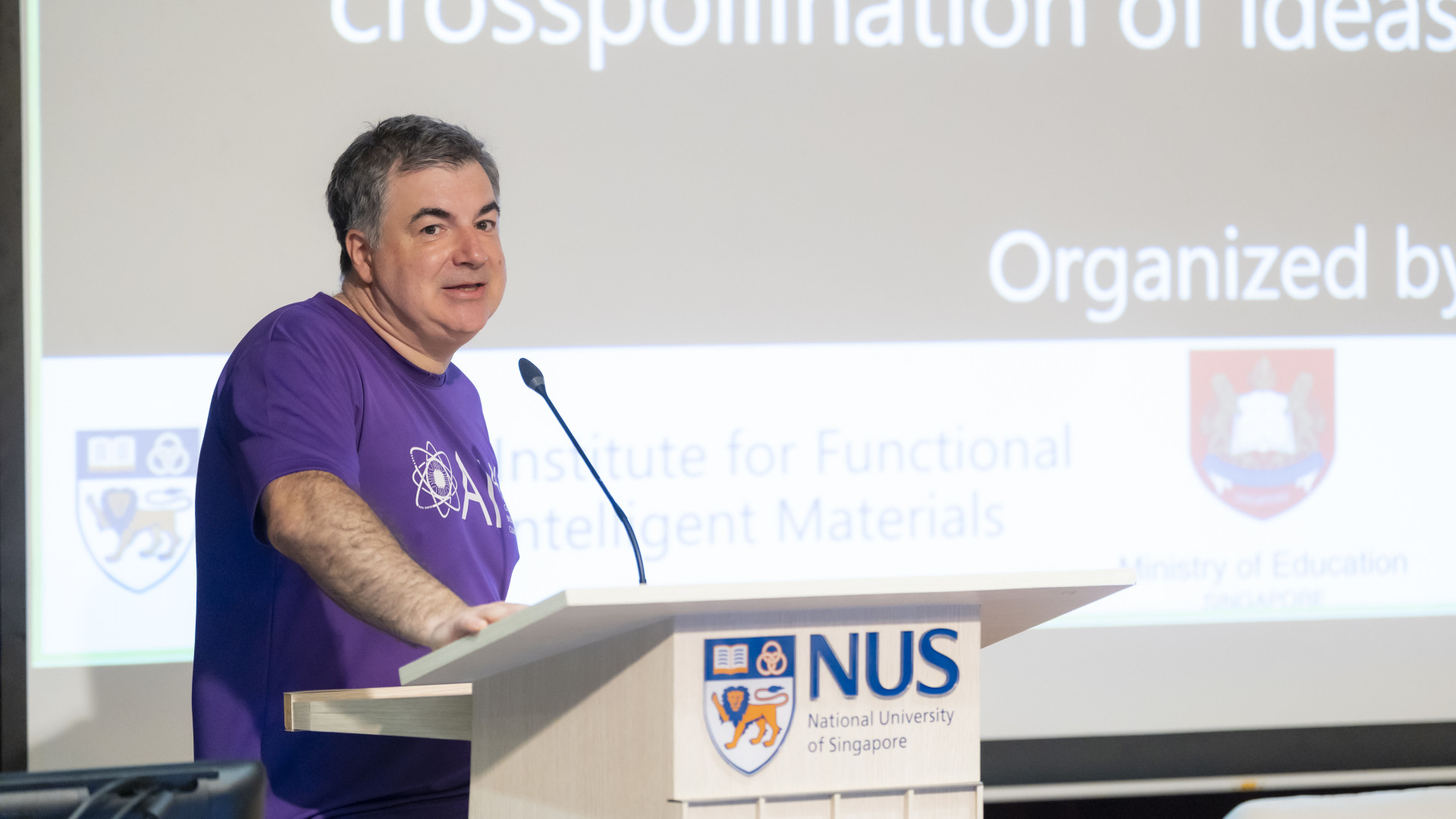
Professor Sir Konstantin Novoselov, Director of NUS I-FIM,President of ACADEMY OF ENGINEERING SCIENCES, SINGAPORE,giving the opening remarks at the AI4X Conference 2025.
Conceived in early 2024, the idea for AI4X was prompted by the increasing investment in the local “AI for Science” initiative, which focuses on the development and adoption of AI methods and tools that are transferable across multiple domains of science. In AI4X, the “X” represents all the scientific disciplines, including Climate, Environment, Medicine, Education, Finance, Mathematics and more.
Prof Novoselov noted that there were many things the researchers could learn from each other as experts from different disciplines. “We attempt to enhance this synergy through a mix of different topics in the talk sessions.”
Leveraging AI to enhance research
Conference speakers shared their views on how AI could further scientific progress, such as helping scientists work in more efficient ways.
The sheer volume of academic literature waiting to be read, combined with time-consuming experiments, often slows down scientific progress, said world-renowned mathematician Professor Weinan E in his talk “Building AI-Powered Infrastructure for Scientific Research”.
“AI can transform the way we conduct scientific research,” he said.
Tools using AI can be used to streamline lab processes and automate experiments. “Instead of doing tedious work, you can spend more time thinking about new ideas,” said Prof E, who is the Inaugural Director of Beijing’s AI for Science Institute and a professor at Peking University’s Center for Machine Learning Research and School of Mathematical Sciences.
One key roadblock to scientific progress, he added, was the “curse of dimensionality”. As a problem’s dimensionality – the number of free parameters it has – grows, so did the amount of compute required using traditional methods. Deep learning, which powers most AI applications today, was the first methodology that could very accurately handle high-dimensional problems, said Prof E, whose team won the 2020 Association for Computing Machinery Gordon Bell Prize for their deep learning-based approach to simulating atomic movement.
Accelerating scientific discovery
Materials science is another frontier being reshaped by AI. The symmetrical atomic structure of a crystal is not merely aesthetic — it also governs its properties, from conductivity to transparency, said NUS I-FIM research fellow Dr Nikita Kazeev in a later presentation “Generation of Novel Stable Beautiful Materials”.
Designing crystals with ideal symmetrical properties would thus lead to the discovery of new materials for stronger batteries, solar cells, and more, explained Dr Kazeev in his talk.
He shared details of a new generative model he helped build, dubbed the “Wyckoff Transformer”, which can design uniquely symmetrical structures much faster than previous models. His team had introduced concepts such as “Wyckoff positions” (special positions that atoms tend to occupy) and “symmetry groups” to the model, which helped it learn about crystalline properties more easily.
What else does the future hold for AI in science? The talks and discussions at the AI4X 2025 Conference has shown that as technology advances, disciplinary boundaries will eventually disappear, with integrated databases and facilities in place.
Plans are underway to make AI4X an annual event, with expanded international participation and deeper industry engagement. The next edition, held in collaboration with the Acceleration Consortium at the University of Toronto, is slated for 2026.