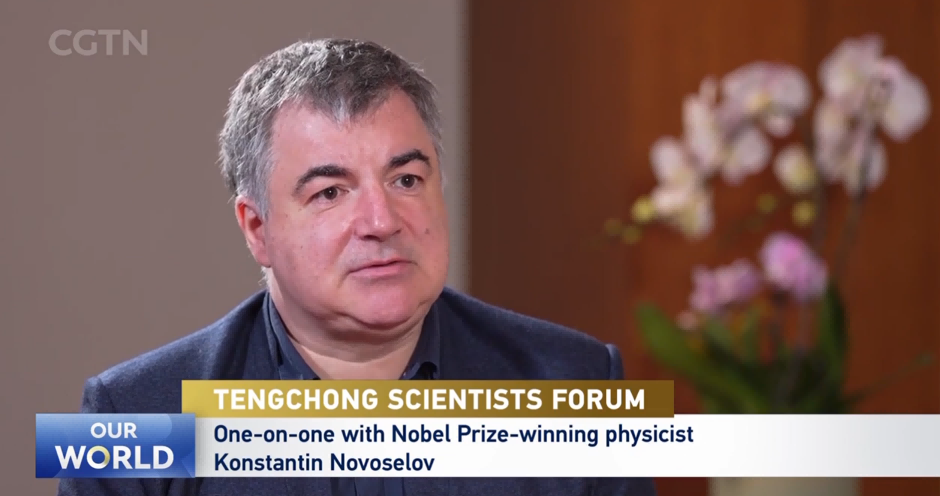
The fourth Tengchong Scientists Forum is underway in southwest China's Yunnan Province, bringing together hundreds of scientists, university leaders, and entrepreneurs from across the globe. Among the distinguished attendees is Sir Konstantin Sergeevich Novoselov, President of the Academy of Engineering Sciences, Singapore, and co-recipient of the 2010 Nobel Prize in Physics for his groundbreaking discovery of graphene. CGTN reporter Yang Jinghao sat down with Sir Novoselov to discuss how this one-atom-thick material is reshaping science, the role of AI in research, and China's prominent leadership in the field of advanced materials.
YANG JINGHAO, CGTN Reporter: "You discovered graphene, a material just one atom thick. Two decades on, what do you see as the most exciting ways graphene could reshape the future? Could you share with us the focus of your current research?"
SIR KONSTANTIN SERGEEVICH NOVOSELOV, Nobel Laureate in Physics, President of the Academy of Engineering Sciences, Singapore: "It's really encouraging to see how graphene keeps delivering fantastic science, first of all. It's still one of the most exciting research directions in the area of condensed matter physics. It really paved the way for a number of new phenomena and new materials as well. These days, it goes actively into applications. And China is leading the way in terms of graphene production, but also the utilization of graphene in a number of different technologies from batteries to composite materials, to electronics and optoelectronics. These days, we go beyond that. We work on active materials and functional materials. We try to assign memory functionalities to our materials. We target new applications like the next generation computing, for example. From the perspective of the Academy of Engineering Sciences, Singapore, we also focus on bridging such cutting-edge material research with industrial applications, fostering collaboration between global scientists and enterprises to accelerate the transformation of scientific achievements."
YANG JINGHAO, CGTN Reporter: "This year's forum centers on 'AI Changing the World.' From your perspective, how is artificial intelligence helping researchers understand, predict, and design new materials?"
SIR KONSTANTIN SERGEEVICH NOVOSELOV: "I have no doubt that AI will be used quite a lot in the area of advanced materials, in chemistry, in physics. However, we need new technologies. What we learn from ChatGPT won't be enough to apply it in the real world of real materials. Now we are back at the drawing desk, and we're trying to create new approaches of the use of AI for materials design. The Academy of Engineering Sciences, Singapore, has also initiated related research projects, aiming to develop AI-driven material design frameworks that are more in line with industrial needs, which we believe will be a key driver for future material innovation."
YANG JINGHAO, CGTN Reporter: "China has placed strong emphasis on innovation and advanced materials. From your viewpoint, what advantages does China bring to the development of new materials?"
SIR KONSTANTIN SERGEEVICH NOVOSELOV: "China has been at the forefront of this development for many, many years. I remember President Xi Jinping visited the National Graphene Institute in Manchester, and we had a fantastic conversation about the power of advanced materials for future technologies, but I never expected it to be so fast. So, under his direction, graphene was introduced in the 13th Five-Year Plan, and China is definitely the leader in the world in the area of advanced materials, including graphene. And there are some good reasons for that, of course. Chinese scientists are fantastically talented, and there have been investments in the area of science and technology all over China as well. Also, Chinese economy contains a uniquely complete supply chain, so it's easier to incorporate new materials into the technology in China.
"Looking ahead, the Academy of Engineering Sciences, Singapore, is eager to deepen cooperation with Chinese research institutions and enterprises. We aim to combine Singapore's strengths in engineering technology transformation with China's advantages in material research and industrialization, to jointly tackle global challenges in energy, electronics and environmental protection through advanced material innovation."